
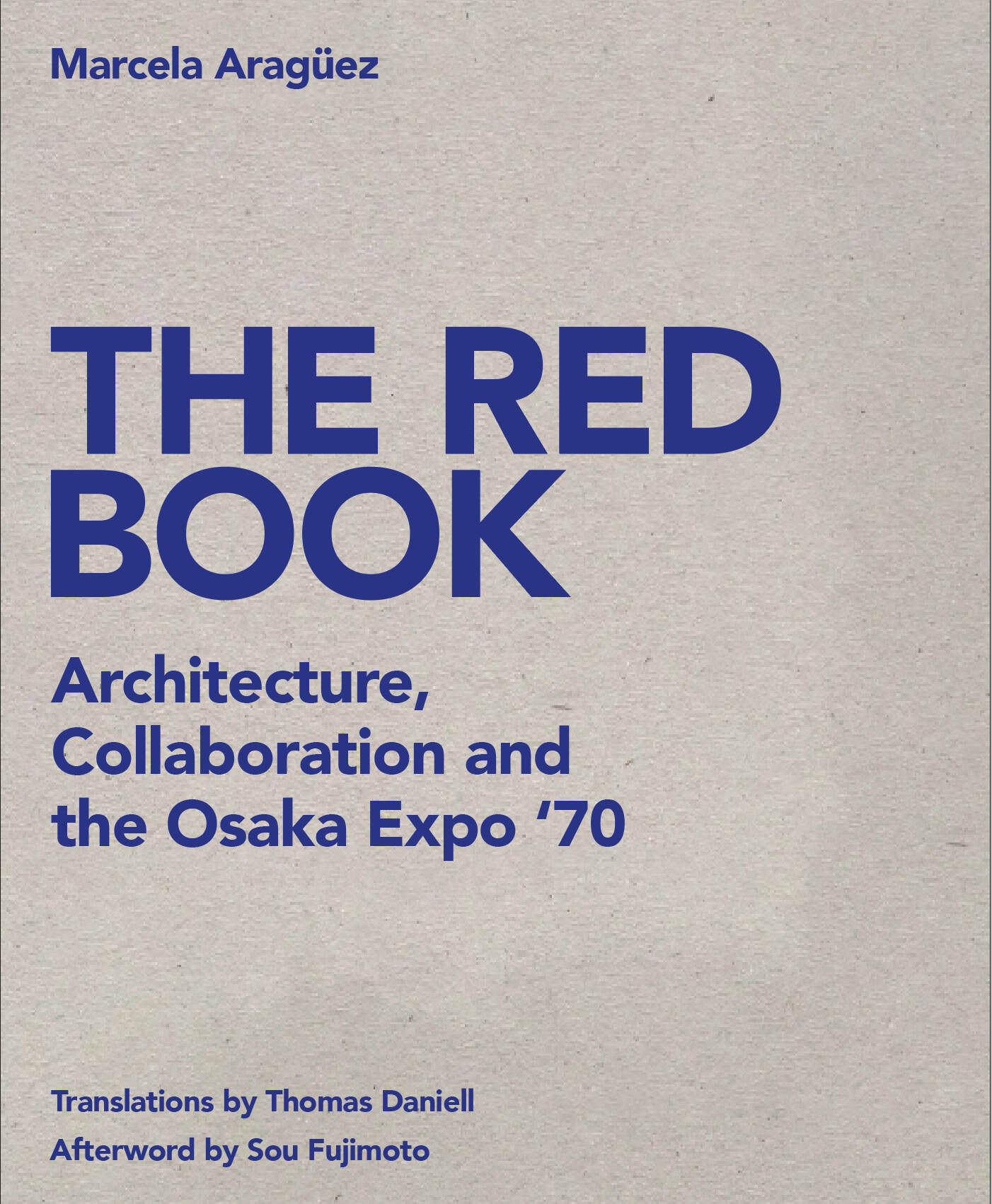
The Red Book: Architecture, Collaboration, and the Osaka Expo ’70
Purchase This Book At:

Description
This volume centers on the Red Book, a little-known 1967 research document that served as the conceptual foundation for Festival Plaza, the central space of Expo ’70 in Osaka. Produced by an extraordinary coalition of architects, artists, engineers, computer scientists, musicians, and writers, the Red Book proposed a radically new form of public space—adaptive, participatory, and technologically responsive. It offers a compelling vision of 1960s Japan as a site of experimental thought and interdisciplinary collaboration. Among other things, it reveals how traditional cultural forms such as festivals were translated into spatial strategies, merging local knowledge with global currents in cybernetics, media theory, and performance.
By translating the Red Book for the first time and situating it within architectural, technological, and cultural histories, this publication brings to light a foundational yet overlooked source in the making of modern Japan. Drawing on perspectives from architecture, religious studies, media theory, and urban planning, the volume unpacks the Red Book’s innovative approaches to design, participation, and control. It challenges dominant narratives of Expo ’70 and broadens the cast of contributors recognized in postwar architectural history. In an era of renewed interest in responsive environments and public space, and particularly in the aftermath of Expo 2025, this work offers timely insights into how past visions of the future were crafted through collective research and creative foresight. It will be of relevance to architects, designers, engineers, artists, scholars, and students across disciplines who are seeking to understand the cultural and technological imagination of the 1960s and its lasting impact on how we conceive, build, and manage collective space today.

Marcela Aragüez is an Assistant Professor of Architecture and Director of the Master in Architecture at IE University in Madrid. She received her PhD in Architectural History & Theory at the Bartlett School of Architecture, University College London, where she also received a Master of Science in Spatial Design (ULC Turner Prize for best dissertation). Marcela’s research focus lies in the production of adaptable architecture, with an emphasis on cross-cultural post war practices. She has recently coordinated the joint research project ‘The Culture of Water’ in collaboration with the Kyoto Institute of Technology in Japan and the Lucerne University of Applied Sciences in Switzerland. She is a licensed architect with professional experience in Spain and Switzerland. Her work has been exhibited at the Haute École D’art et de Design in Geneva (HEAD) and the École Polytechnique Fédérale de Lausanne (EPFL). Marcela has lectured widely in the UK, Switzerland, Japan, France and Spain and her work has been acknowledged by grants and awards from institutions such as the Japan Foundation, Sasakawa Foundation, Canon Foundation and the Society of Architectural Historians of Great Britain. She has published in international journals such as Roadsides and Architectural Research Quarterly, and is a General Editor of Architectural Histories.
